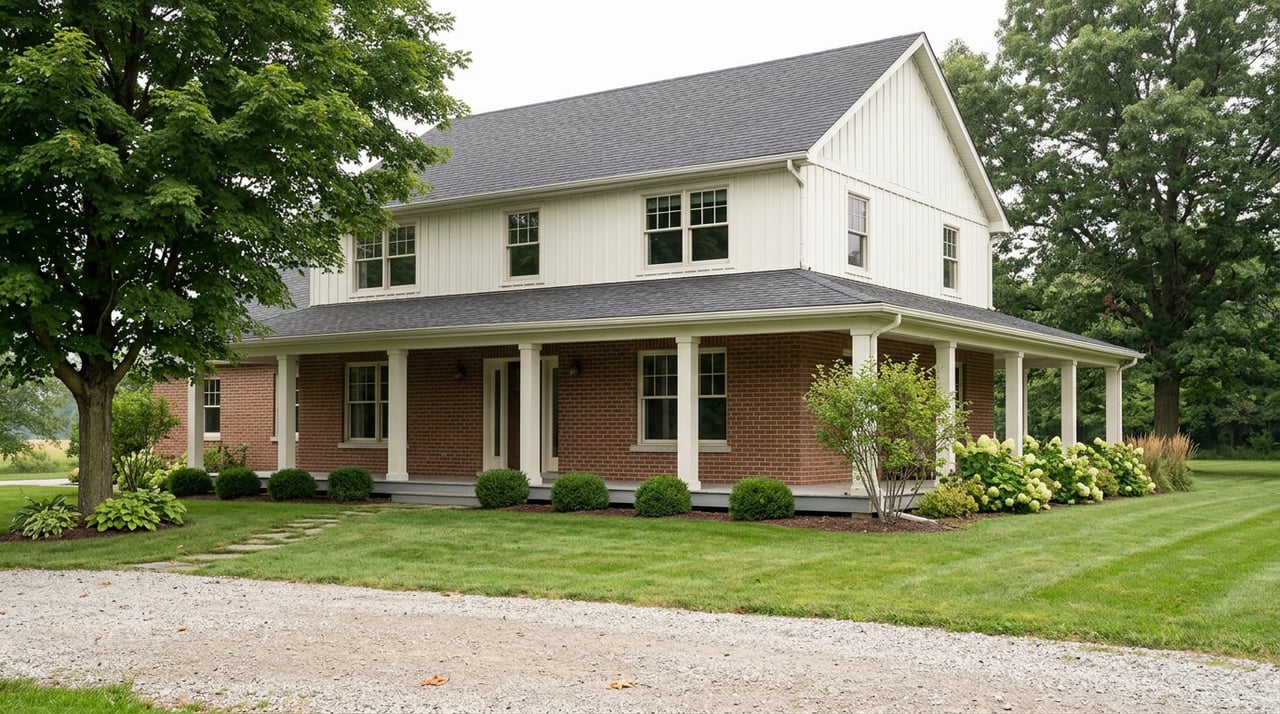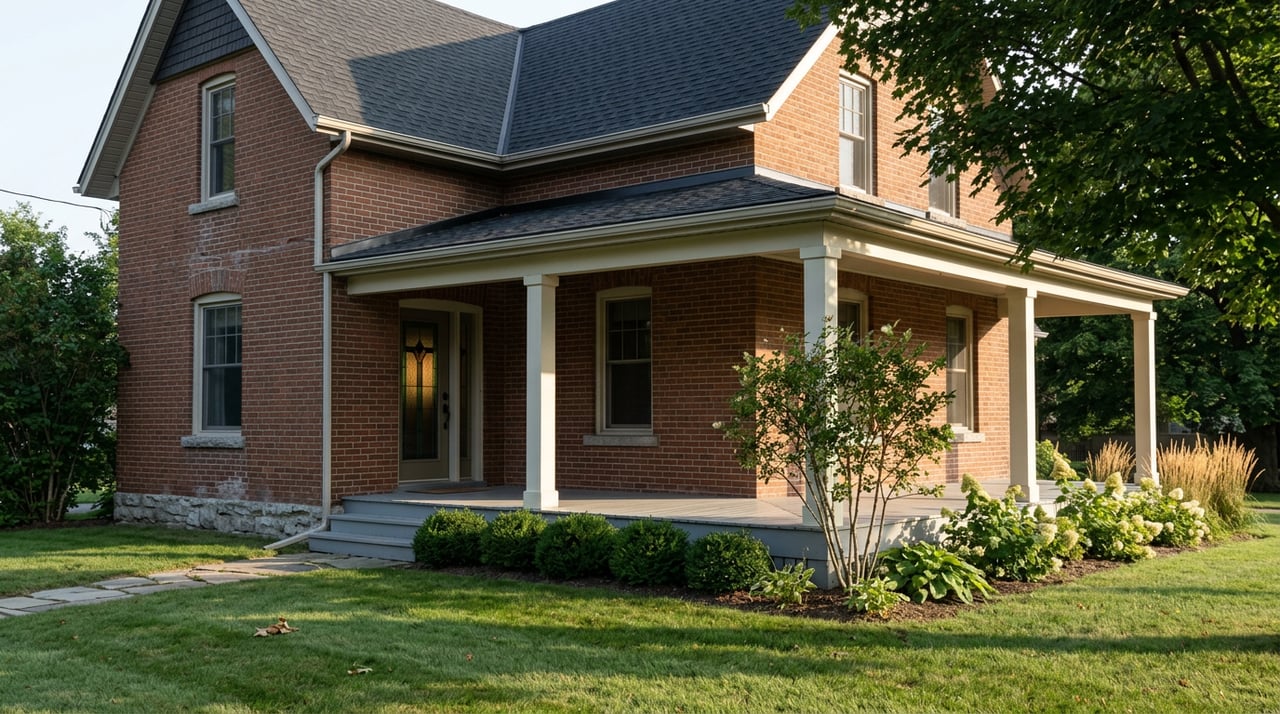
The listing portals will tell you that a detached home in Puslinch sits at roughly $1.9 million on the sold side and $2.28 million on the ask, on parcels averaging 3,581 square feet of house against a regional average closer to 1,856. Those numbers are accurate. They also miss the three mechanisms that decide whether the price is fair, and none of them are visible in an MLS photograph.
Puslinch is the only Township in this part of Southwestern Ontario where a buyer is simultaneously paying luxury-estate money and inheriting the full obligations of a rural site: private water, private waste, private stormwater, and a planning file that runs through both the Township and the County of Wellington. A buyer coming out of Waterloo Region or the western GTA is often surprised to learn that no piece of that stack is optional, and that a decision the County made in May 2025 has quietly changed what a large parcel can become.
The mechanism the portal cannot show you: May 1, 2025
At the County of Wellington's virtual open house on Wellington County Official Plan Amendment No. 131, held February 5, 2026, staff confirmed two facts that reset how buyers should read Puslinch inventory. First, the severance reset date for the Township is May 1, 2025. Second, the current plan only permits severances in a secondary agricultural area that qualify under the earlier March 1, 2005 date, unless and until OPA 131 changes that framework.
Translated for a buyer who is considering acreage as a legacy hold, a family compound, or a long-horizon land bank: the severance history attached to your target parcel is not a static disclosure. It is a countdown clock. If a previous owner used a severance under the old regime, that use is now weighed against the new reset. If your business case for the price depends on the future creation of a second lot, that assumption needs to be tested against the parcel's post-2005 severance history and the March 2005 qualifying-date rule, not against a general sense that "rural land can be split." The County has published a summary of the open house at wellington.ca, and any real diligence on an acreage buy in Aberfoyle, Morriston, or the concession roads in between now starts there.
A related point from the same session is worth stating plainly. When a resident asked whether municipal water and wastewater servicing was coming to the Puslinch area, County planning staff answered that municipal servicing is not available in Puslinch and that water and wastewater are privately provided. That answer applies at the Aberfoyle hamlet scale, and it applies to the estate subdivisions dotted along Sideroad 20 North and Concession 1. Every offer a buyer writes in this Township is an offer on a private-servicing property.
The free diligence asset almost no buyer asks for
Because Puslinch sits over a shared groundwater system, the County of Wellington runs a Mandatory Septic Inspection Program through Wellington Source Water Protection. Any property whose septic system falls inside a highly vulnerable municipal wellhead protection area or intake protection zone is required to have its septic system inspected every five years, and the most recent inspection cycle commenced in May 2023. There are roughly 775 properties across the County caught by the program. In Puslinch specifically, there is no cost to the resident, and completed reports are filed with the Township building department at [email protected]. The program's mechanics are documented at wellingtonwater.ca.
The buyer-side reading of that program is the part rarely discussed at the offer table:
If the parcel you are buying is inside one of those protection zones, a current professional inspection of its septic system may already exist in the Township file. The seller did not pay for it. You do not have to pay for it. But you do have to ask for it, in writing, before you waive conditions.
A buyer who orders a private septic inspection without first requesting the County-mandated report is paying for a second opinion on a document they could have obtained for free. Worse, a buyer who does not request it may accept a general "septic in working order" clause on a property where a five-year mandatory review is due within the year, along with any repair conditions the inspector attached. That is a transaction-specific friction that only shows up in Puslinch, Centre Wellington, Erin, Minto, Wellington North, and Guelph/Eramosa. A buyer coming from Hamilton or Halton has no cultural memory of it.
The number that rewrites the building envelope
The third mechanism sits inside the Township's own planning file and is easiest to see in a recent Planning and Development Advisory Committee agenda. Report PDAC-2026-002 and the companion consent report, considered at the February 10, 2026 meeting, addressed a lot line adjustment between 4078 Highway 6 and 7463 Leslie Road West. The severance sketch, prepared by Van Harten Land Surveyors, had to demonstrate two things at once: sufficient area on both the severed and retained parcels for a detached dwelling and an associated septic system, and compliance with the Minimum Distance Separation (MDS I) formulae. The Township's report language is preserved in the February 10 2026 PDAC agenda.
MDS I is not intuitive if you have not built rural before. It is the provincial formula that sets a required distance between a proposed new dwelling and any existing livestock facility on a neighbouring property, calibrated to the type and number of animals housed there. On paper the buyer owns the acreage. In practice a neighbour's barn can shift the practical building envelope by tens of metres, and can render a beautiful hilltop building spot ineligible for a permit. Where a parcel also touches a Natural Environment zone, an Environmental Impact Study by a qualified consultant is often required, together with a development agreement covering peer review and cost recovery, again per the PDAC report.
For a buyer, this means the answer to "can I build the house I have in mind, where I want to put it, on this specific lot?" is not answered by acreage or by zoning alone. It is answered by MDS I outputs against the surrounding agricultural operations, by any NE overlay on the parcel, and by the Township's site plan expectations, all of which sit inside the CloudPermit application system used by Puslinch Planning and Development.
Reordering the diligence stack
The standard Southwestern Ontario rural checklist assumes a private well, a private septic, and a survey. In Puslinch, the sequence that actually protects a buyer looks different:
- Pull the parcel's severance history from the County of Wellington Land Division Committee and read it against the May 1, 2025 reset and the March 1, 2005 qualifying date.
- Ask the Township, in writing, whether the property is inside a wellhead protection area or intake protection zone, and whether a Mandatory Septic Inspection Program report is already on file.
- Confirm the applicable zone under Comprehensive Zoning By-law 023-18. Agricultural (A) and Natural Environment (NE) overlays behave very differently, and holding provisions on lots inside estate subdivisions can block development until a site plan is registered.
- Where a new dwelling, addition, or accessory structure is contemplated, run an MDS I calculation against neighbouring livestock operations before conditions are waived.
- Order the well flow test, water quality panel, and independent septic inspection in the order that makes sense once the file above is in hand, not before.
The order matters because each step can change the value of the ones that follow. A parcel that fails the severance math is worth less than one that passes it, even at identical square footage. A property with a current mandatory septic report in the Township file needs a smaller inspection scope than one without. A parcel whose building envelope is bounded by MDS I may not support the house the buyer has been quietly designing.
FAQ
Does the May 1, 2025 severance reset apply to properties I look at today?
The reset date under OPA 131 applies to Township of Puslinch severance applications as described by County planning staff at the February 5, 2026 open house. Any parcel whose price relies on future severance potential should be evaluated against both the reset and the March 2005 qualifying-date rule, ideally at the pre-consultation stage with the Township.
Is there any municipal water or sewer in Puslinch?
No. County planning staff confirmed at the February 5, 2026 open house that municipal servicing is not available in Puslinch. Every property in the Township is on private water and private waste, including the hamlets of Aberfoyle and Morriston.
Who pays for the mandatory five-year septic inspection?
In Puslinch there is no cost to the resident, per Wellington Source Water Protection. In Guelph/Eramosa the program carries a $50 annual fee on the property tax bill. The other participating municipalities are Centre Wellington, Erin, Minto, and Wellington North.
What is MDS I in one sentence?
It is the provincial Minimum Distance Separation formula that sets a required setback between a proposed dwelling and a neighbouring livestock facility, and it can compress the practical building envelope on a Puslinch parcel well inside the surveyed lot lines.
If you are evaluating an acreage purchase in Puslinch, or preparing to bring one to market, the questions above are worth answering before the offer, not after. Kevin, Alicia & Associates advises on estate, farm, and land transactions across Puslinch and the surrounding County of Wellington. Book a property valuation to price your parcel against the mechanisms that actually move Puslinch value in 2026.