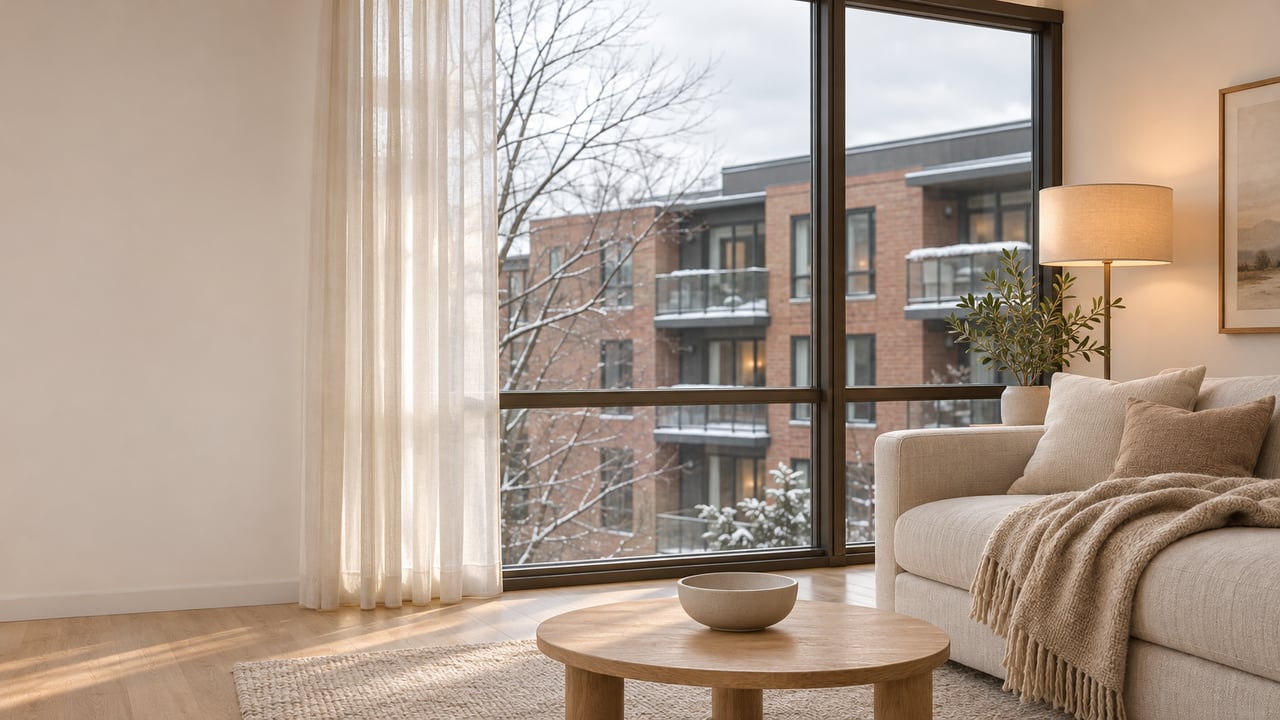
The condo towers along King Street in downtown Kitchener belong to the slowest-moving segment of the Waterloo Region market this fall. Cornerstone Association of REALTORS recorded 7.1 months of supply for condos in October 2026, against 3.1 for single-family homes. At October's pace of sales, the condo inventory on the market would take more than twice as long to sell as the single-family inventory.
That surplus sits in front of a pipeline that has nearly emptied. Investors who bought condos for rental returns found the numbers no longer worked, and pre-construction condo sales in Kitchener fell to almost nothing in 2025. A buyer comparing a condo with a townhouse or a detached home this winter is choosing between segments at different points in their cycles.
Two Octobers Apart, the Price Ratio Moved
On Cornerstone Association of REALTORS' Waterloo Region statistics page, the average condo sale price was $482,771 in October 2024, $433,832 in October 2025 and $392,861 in October 2026. That is a 9.4% drop over the past year and roughly 19% over two years. Over the same two Octobers, the single-family average went from $885,464 to $826,873, about 6.6% lower, and fell just 1.1% in the latest year.
Divide one average by the other and the change is clearer. In October 2024, the average Waterloo Region condo sold for about 55% of the average single-family home. In October 2026 it sold for about 48%. These are regional averages, so they mix downtown Kitchener towers with units in Cambridge and the townships, and they do not compare like-for-like units. Even so, they show the two segments separating. The broader Kitchener-Waterloo MLS® HPI benchmark was $624,600 in October 2026, down 4.7% year over year, which falls between the two.
Supply moved the same way. Condo months of supply was 5.3 in October 2024, peaked at 7.5 in October 2025 and eased to 7.1 this October. Single-family supply held at 3.1 months in both 2025 and 2026. If the whole regional market were weak, both segments would show it. Instead, one segment is holding steady and the other is carrying the surplus.
The Investors' Numbers Changed Before the Rental Market Did
A surplus this size could mean Kitchener-Waterloo has more condos than people who want to live in them. The rental data does not support that. In its 2025 Rental Market Report, published December 11, 2025, CMHC put the vacancy rate for rented condominiums in Kitchener-Cambridge-Waterloo at 0.8%, with an average two-bedroom rent of $2,197. Purpose-built apartments in the same area had 4.1% vacancy and a $1,832 average two-bedroom rent. Rented condos were finding tenants at higher rents than the purpose-built buildings nearby.
The pressure showed up in investors' returns. Broker Brian Santos told the Waterloo Region Record this spring that more bachelor and one-bedroom units are on the market, that investors would typically have bought these units, and that "the numbers aren't working for them." He said sellers whose units sit on the market keep paying condo fees and taxes, and face declining rents if they rent the unit out instead.
Student demand has also fallen. CTV Kitchener reported in May 2026 on a regional report that attributed a net decline of 9,070 students to the federal study-permit caps. The Record found that Conestoga College received 8,060 new or extended international-student permits in 2025, compared with 32,495 in 2023. CMHC said the cap eased rental demand in the student-heavy Waterloo zone in 2025. That lower demand adds to the pressure on investor sellers, and the 0.8% rented-condo vacancy rate shows it has not left the units empty. The condo discount reflects what an investor can earn from a unit more than whether anyone wants to live in it.
The Pipeline Behind the Surplus Has Nearly Stopped
The Record reported in the same article that Kitchener had 13 pre-construction condo sales in all of 2025, against an average of 497 a year from 2021 to 2024. That is a 97% decline. Waterloo had 14 in 2025, compared with a four-year average of 102. The figures come from the RESCON and Missing Middle Initiative report card released April 30, 2026. Earlier, CTV Kitchener reported on the Missing Middle Initiative's count of 29 pre-construction condos sold across Kitchener, Cambridge and Waterloo from January to September 2025, down 94% from the same period in 2021 to 2024.
Pre-construction sales take years to become finished units, so a year with almost no sales in 2025 means little new condo supply years from now. Santos told the Record: "There's almost no new pre-construction happening; its dried up. In three or four years, if you have no construction now, there's going to be less units then." He added that most current projects are purpose-built rentals.
The larger projects still moving forward started in the earlier cycle. The four-tower, 622-unit site at 1333 Weber St. E., first marketed as Elevate, stalled before new owners took it on, and the Record reported that they intend to complete the development, with rental under consideration for one tower. Its first tower has reached occupancy, with 148 of its 177 units granted occupancy permission according to the Record, and the remaining towers of the plan are still ahead.
What a Condo Buyer Has That a Townhouse Buyer Doesn't
For someone moving to the region, the segment determines how much bargaining room they have. Across Waterloo Region in October 2026, semi-detached homes had 1.8 months of supply, single-family homes 3.1, townhouses 4.3 and condos 7.1. A buyer who switches from a condo search to a semi goes from the segment with the most supply to the one with the least. The semi-detached average price fell 0.8% in the past year, compared with 9.4% for condos.
The two cities also differ. In October 2026, Waterloo had 114 sales across all property types, up 2.7% from a year earlier, while Kitchener had 203, down 17.8%. These citywide figures are not broken out by property type, but they show sales falling in Kitchener while they rose in Waterloo this October. A buyer looking at condos in both Kitchener and Waterloo gets a clearer read by comparing each city's recent sales separately than by treating them as one market.
The Other Side of the Cycle
The surplus is smaller than it was at its peak. Condo months of supply fell from 7.5 to 7.1 between October 2025 and October 2026. The Record reported 8.6 months at the end of April. October's figure is still more than double the single-family figure.
Santos also told the Record he is seeing more first-time buyers purchase condos to "climb that property ladder" now that prices have dropped. Broker Tina Goldrick called the decline the market "correcting itself over time" after years of unrealistic pricing.
Cornerstone's November figures will be released in early December. The number to watch is condo months of supply against the 7.1 recorded for October 2026.
If you own a condo in Kitchener-Waterloo and need to know where your unit stands in this cycle, or you are weighing a condo against a townhouse or freehold home for your next move, Kevin, Alicia & Associates would be glad to talk it through with you. Book a property valuation to start that conversation.